
When to Plant Fescue in North Carolina: The Piedmont Seeding Window

If you are reading this in early September, you are inside the window. That is not a sales line. It is what two separate NC State Extension publications say, and it is the single most consequential date in a Piedmont lawn year.
The Piedmont window is September 1 to October 1

Tall fescue is the dominant lawn grass across the North Carolina Piedmont, and Extension gives it a seeding window roughly four weeks wide. Two NC State sources agree on the Piedmont dates: the regional seeding table in Carolina Lawns and the Tall Fescue Maintenance Calendar.
The dates are not the same statewide. Extension publishes them by region because the compromise is different in each:
Mountains: August 15 to September 1
Piedmont: September 1 to October 1
Coastal plain: September 15 to October 15
Extension's outer limit for cool-season grasses statewide is mid-August through October 1, depending on location, and it is explicit that seeding past those dates raises the risk of failure from winter injury. The seedlings simply do not have enough root before the first hard cold.
If you live in Union, Mecklenburg, Cabarrus, Iredell, Gaston, Rowan, Stanly, Anson or the surrounding counties, the Piedmont row is yours.
Why fall and not spring
This is the question homeowners ask most, usually in March, usually after a winter of looking at bare patches.
Extension's reasoning is about roots and heat. Spring and late-winter seedlings are, in its own assessment, often less than satisfactory, because the seedling roots do not have time to become well established before the heat and drought of summer arrive. A March-seeded fescue lawn is a four-month-old plant walking into July in the transition zone.
The maintenance calendar reinforces this from the other direction, and it is worth noticing how consistently it does so. For March through May, it says to delay aeration until fall. For June through August, it says to delay aeration until fall again, and adds: do not use herbicides at this time. Extension is quietly steering nearly every piece of lawn establishment work out of spring and into September.
That is why the window matters so much here. Miss it and your options get materially worse for a full year, not a few weeks.
Seeding rates, and the one nearly every article gets wrong
Extension gives four distinct cases, and they are not interchangeable:
New lawn, tall fescue: 6 lb per 1,000 sq ft. (Carolina Lawns, Piedmont Table 2b)
Overseeding thin or bare areas: 6 lb per 1,000 sq ft, using a blend of turf-type tall fescue cultivars. (Tall Fescue Calendar)
Seeding into existing vegetation: reduce the rate by 25 to 50 percent, so roughly 3 to 4.5 lb per 1,000 sq ft. (Carolina Lawns, Renovating a Lawn)
Kentucky bluegrass / tall fescue mix: 1 lb plus 5 lb, and note the window tightens to September 1 to 15. A KBG / tall fescue / fine fescue mix runs 1 + 5 + 1 lb, August 15 to September 15.
Case three is the one that gets missed. Almost every consumer lawn article quotes the 6 lb figure and stops there. But broadcasting a full new-lawn rate into a lawn that already has grass in it puts your new seedlings in competition with each other on top of the competition they already face from established turf. Extension says drop the rate by a quarter to a half. Most Piedmont homeowners overseeding a thinning fescue lawn are in case three, not case one.
Seedbed preparation, in Extension's terms
The prep guidance is more specific than most people expect, and the specificity is the point.
Break the soil down so particles are no larger than marble size. Pea gravel size is better.
Spread with a rotary or drop spreader, applying half the seed in one direction and the other half at right angles to the first pass. This is the difference between even coverage and visible striping in October.
Lightly cover the seed by hand raking, or by dragging a mat or a span of chain-link fence across it.
Roll the soil lightly to firm the surface and get good seed-to-soil contact.
Replant any bare spot larger than about four inches across.
On our red Piedmont clay, the marble-size instruction is the hard part. Clay does not break down into a fine seedbed when it is wet, and it sets like fired pottery when it is dry. The practical window for working it is a couple of days after rain, not the day of and not two weeks later.
The first three weeks decide the outcome
Keep the top inch and a half of soil moist. Extension is blunt that this may require light watering two or three times a day for 7 to 21 days. This is the opposite of established-lawn advice, where the rule is deep and infrequent. New seed has no root system to reach down with, so shallow and frequent is correct until it does.
First mow when the grass reaches 50 percent above target height: let it hit 4.5 inches, then mow back to 3.
Fall fertility and aeration, while you are out there
For September through November, Extension calls for 1 lb of nitrogen per 1,000 sq ft in mid-September and again in November, using a 3-1-2 or 4-1-2 ratio product such as 12-4-8 or 16-4-8.
Fall is also the aeration window, specifically for lawns on clay soils or with heavy traffic, which describes most yards in this part of the state. Remove the plugs, break them up, and return the soil to the lawn.
One thing you can skip: Extension states that for tall fescue it is generally not necessary to remove thatch. Worth knowing before you pay someone to dethatch.
Where the sources are quieter than you would like
Two honest caveats.
First, Extension publishes the fescue year as four seasonal blocks, not twelve months. Where a specific month appears above, Extension named it. Where the guidance is block-level, we have not invented a month to make the calendar look tidier. Any guide that gives you a clean date for every task is filling gaps the source did not fill.
Second, grub control timing is genuinely unsettled. Extension notes that spring curative applications are not effective, points to June for prevention, and says early fall curatives may work but that efficacy varies. That is a real hedge in the source, and we are passing it along as a hedge rather than resolving it for you.
If you want the whole year on paper
This post covers establishment. The full NC Piedmont Lawn Calendar covers the entire year for tall fescue, bermudagrass, zoysiagrass and centipedegrass, with mowing heights, nitrogen amounts, weed timing, water and disease guidance in a season-by-season grid, plus NC State's six-point species comparison table for shade, heat, cold, drought and wear tolerance. Every figure is traced to the Extension publication it came from.
When the problem is not the seed
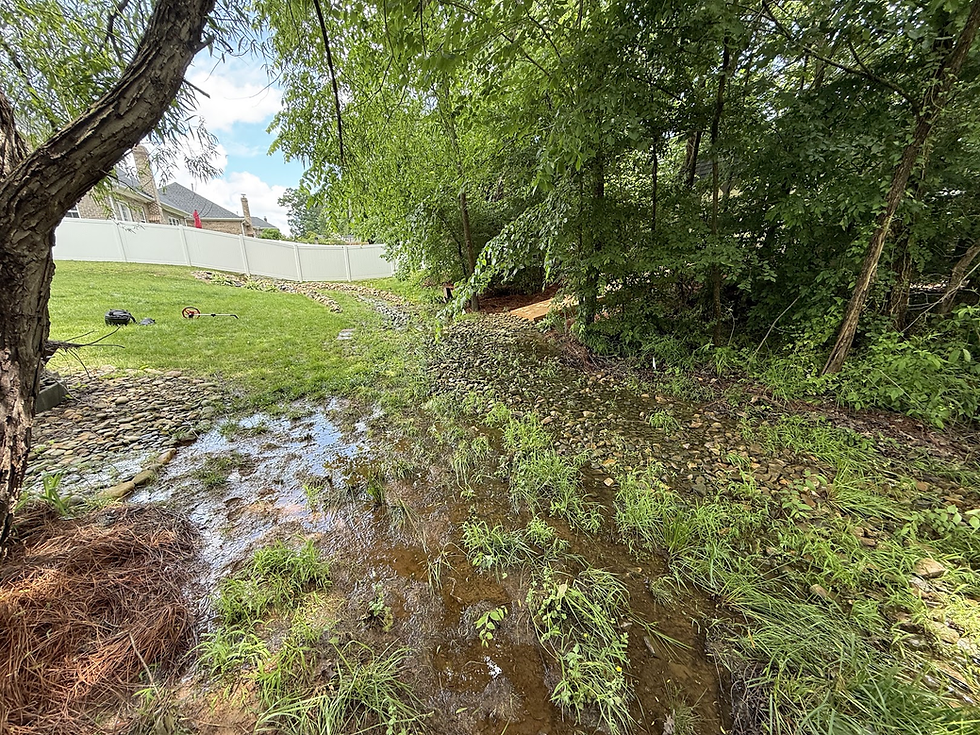
A fair number of thin fescue lawns in Waxhaw, Weddington, Marvin and south Charlotte are not thin because of seeding dates. They are thin because water sits where it should not, or because the soil under them is compacted clay that roots cannot get into. Reseeding a drainage problem in September just means reseeding it again next September.
If your bare areas track the same path down the yard every year, or stay soggy for days after a storm, that is a grading and drainage question rather than a turf question. That is the work we do. You can request a consultation here.
Alex Purdy, Carolina Terrain, Waxhaw, North Carolina. NC Landscape Contractor License CL.1872, NCSU Stormwater SCM Inspection and Maintenance Certification #5970, NDS Certified Drainage Contractor. This is an educational summary compiled from NC State Extension and NCDA and CS publications, written for the North Carolina Piedmont. I am a licensed contractor, not a professional engineer and not a registered landscape architect. It is not a plan for a specific address.
Sources: NC State Extension, Carolina Lawns: A Guide to Maintaining Quality Turf in the Landscape (regional seeding tables and Renovating a Lawn). NC State Extension, Tall Fescue Maintenance Calendar. NC State Extension Gardener Handbook, Chapter 9: Lawns.


Comments