
The raised bed mistake almost every build plan repeats

I get called out to gardens where the raised beds are not working. The carpentry is almost never the problem. Corners are square, boards are sound, the thing is level. The problem is nearly always underneath, and it usually started with a well-intentioned decision made on day one.
Someone put a layer of gravel in the bottom “for drainage.”
I understand the instinct completely. Gravel drains. Soil holds water. Put the draining thing at the bottom and water leaves faster. It is such an obvious piece of reasoning that it appears in a large fraction of the raised bed build plans you can buy online, and it is wrong in a way that actively makes the bed worse.
What actually happens at the boundary
Water does not flow smoothly from a fine material into a coarse one. It stalls at the boundary. The soil above has to become saturated before gravity can overcome the capillary tension holding water in the small pores, and only then does water begin to move down into the gravel.
The result is a band of permanently wet soil sitting at the base of the bed, which soil scientists call a perched water table. It sits there whether or not you added gravel — but the gravel changes where the top of it lands.
The University of Missouri Extension puts the mechanism plainly: “By adding a non-capillary layer of material to the bottom of a container, the depth of the water column in the container is shortened and drainage is reduced.”
Read that twice. Drainage is reduced. Not improved.
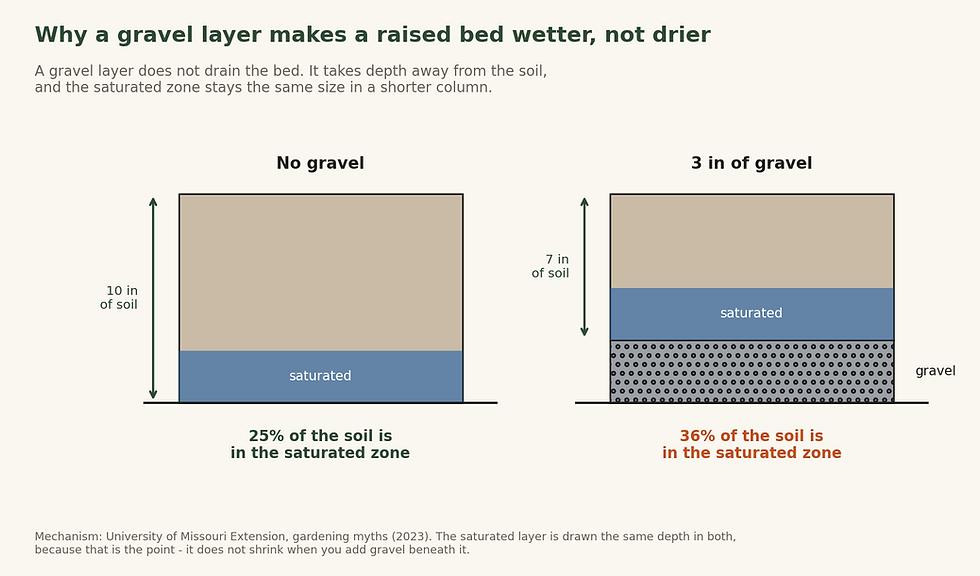
The arithmetic is the uncomfortable part. Take an 11-inch bed holding 10 inches of soil, with a saturated band of roughly two and a half inches at the base. That is a quarter of your soil sitting wet. Now add three inches of gravel. You still have the same saturated band, but now only seven inches of soil sit above it — so the wet zone is more than a third of your growing medium, and it has moved upward into the part of the bed where roots actually live.
You have not drained anything. You have spent money and effort to shrink the usable soil and raise the waterline.
The same mistake in a smaller pot
If this sounds familiar, it is because it is exactly the crocks-in-the-bottom-of-a-flowerpot advice that got passed down for generations. It is the same physics at a different scale, and it is wrong for the same reason. The Missouri guidance suggests the actual fix for a container: use a taller one, so the water column has more height to push with.
That translates directly to beds. If drainage is your concern, build the bed deeper, not layered.
So what do you actually do?
Four things, in order of how much difference they make.
One: put the bed where water already leaves. This is worth more than everything else combined and it costs nothing. Go outside during a hard rain — not after it, during it — and watch where water sheets across the ground and where it stands. If a spot still holds water an hour after the rain stops, that is not where the bed goes. No amount of bed height fixes ground that does not drain, it just hides the problem for a season or two.
Two: break up the ground underneath before you fill. Drive a garden fork in and rock it, on roughly six-inch centres, across the whole footprint. You are not excavating. You are softening the boundary so it is less of an abrupt change in texture. In our piedmont clay this takes about fifteen minutes for a 4×8 bed and it is the best fifteen minutes you will spend on it.
Three: go deeper if you are worried. A three-course bed at 16½ inches holds a deeper column than a two-course bed at 11 inches, and the deeper column drains better. That is the same principle as the taller pot.
Four: do not try to fix clay with sand. This is the other great well-meant disaster. Illinois Extension is blunt about it — mixing sand into clay creates “a soil structure akin to concrete,” and you would need roughly a 1:1 ratio of sand to clay to change the structure at all, which is an absurd volume of sand. Organic matter is what improves clay. Sand makes brick.
One thing I will not tell you
I am a licensed landscape contractor and a certified drainage contractor, and I am not going to diagnose your garden from a blog post. If water is standing against your foundation, or a retaining wall is moving, that is not a raised bed question and some of it is engineering work — I am not a Professional Engineer and you should hire one.
But the gravel thing? That one I can settle from here. Don't.


Comments